Showing posts with label whitechapel. Show all posts

Monday, 30 September 2024

Date With History: 1888

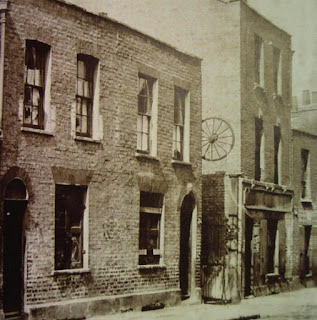
Berner St. circa 1908
The Whitechapel Murders
escalated as the killer, now
known as Jack the Ripper (he
was christened in the 'Dear
 Boss' letter just three days
before), attacked two more
 prostitutes on the same night.

The first victim of the 'Double
Event' was Elizabeth Stride,
murdered at about 1 am, on
Sunday September 30th, in
Dutfield's Yard, on Berner 
(now Henriques) Street.

Less than an hour later,
Catherine Eddowes became
the fourth canonical victim of the Ripper. She was slain in Mitre Square, Aldgate, within the City of
London itself, at around 1.45 am.

Mitre Square reconstructed
for CSI: Whitechapel (2012)
Then at about 3 am, PC Alfred
Long discovered two clues in
nearby Wentworth Dwellings
on Goulston Street. A bloodied
portion of Eddowes' apron lay
 in a stairwell, and above it,
written in chalk on the wall,
was this message: "the Juwes
are the men that will not be
blamed for nothing." The true
 import of this 'graffito' is still
unclear - compounded by Met
police Commissioner Charles
Warren's insistence on having
it erased.


Sunday, 9 December 2012

Ripper Street Preview

I first wrote about this forthcoming BBC thriller way back in January (read here), which is now scheduled to begin transmission on Sunday, December 30th.

BBC One commissioned the new, eight-part period drama, Ripper Street in September 2011. Created by Richard Warlow, the series "is set in the East End of London in 1889, during the aftermath of the" Whitechapel Murders.
The original press release states that "the action centres around the notorious H Division - the police precinct from hell - which is charged with keeping order in the chaotic streets."
Produced by Tiger Aspect, the series "explores the lives of characters trying to recover from the Ripper's legacy, from crimes that have not only irretrievably altered their lives, but the very fabric of their city. At the drama's heart our detectives try to bring a little light into the dark world they inhabit." The programme's cast is led by Matthew Macfadyen (pictured) as real-life Inspector Edmund Reid, Jerome Flynn as Sergeant Bennett Drake, and Adam Rothenberg as Captain Homer Jackson. 

From it's inception in 1829, the Metropolitan Police was divided into seventeen districts for administrative purposes, and each was identified by a letter. 
 In 1888, H Division covered Whitechapel, and it's jurisdiction included three Ripper murder sites: Hanbury Street (Annie Chapman), Berner Street (Elizabeth Stride), and Miller's Court (Mary Kelly). The four police stations within the district where at Leman Street (the divisional HQ), Commercial Street (the area CID office), Arbour Square, and King David Lane. At the time, the Division was responsible for policing just 1 and a quarter square miles, but which housed some 67,000 poverty-stricken souls.
The officer in charge of detectives on the ground during the Whitechapel Murders, was Inspector Frederick Abberline (1843-1929) - he had worked in H Division from 1873-1887. 
Ripper Street features the actual Head of CID, Inspector Reid (1846-1917), who had led enquiries into the (non-canonical) murders of Emma Smith (in April 1888) and Martha Tabram (the following August). He retired in 1896, and later claimed that Frances Coles (killed in February 1891) had been Jack the Ripper's ninth, and final victim. 
Since 1965, H Division has covered Tower Hamlets.

Wednesday, 1 August 2012

Review of 'The Candle Man' by Alex Scarrow

I first encountered Alex Scarrow's excellent body of work two years ago. His titles are highly recommended (read my review of October Skies here), and I was pleased to discover his latest thriller, The Candle Man (Orion).
 I really tried to enjoy this book because I loved the writer's previous work and the novel offers so much to the Ripperologist in me.
The narrative begins promisingly on RMS Titanic, just after her rendezvous with the iceberg, then transports us to London's 'Autumn of Terror' in 1888.
And I really wanted Scarrow to proffer his own, original approach - unfortunately we are presented with yet another re-hash of the 'Royal conspiracy'.
This criticism is not detrimental to the novel however, which is as evocative as any worthy piece of Victoriana, and one of the author's many strengths lies in his (almost Holmesian) attention to period detail. I suspect that Scarrow - like many other writers since the 1970's - relishes in an admittedly compulsive and entertaining theory. Also akin to other proponents of this particular 'final solution', this novelist allows the final canonical victim, Mary Kelly, to escape her true destiny too.
Granted, this is a fictional account of the Whitechapel Murders and the historical minutiae is as accurate as you'd expect from Scarrow, but it's hard to forgive his most glaring error - the 'Double Event' occurs here two days later than documented (and I'm sure that the cover artwork depicts the Lusitania, not Titanic).
The story ends back onboard the sinking liner, and the mystery of Jack the Ripper is solved. Despite my negative opinions, The Candle Man remains a good read, and I look forward to Alex Scarrow's next title.

Thursday, 19 January 2012

Coming Soon: Ripper Street

H Division's actual CID officers, pictured in 1889

Last September, BBC One commissioned a new, eight-part period drama called Ripper Street. Created by Richard Warlow (a writer on Waking the Dead), the series "is set in the East End of London in 1889, during the aftermath of the" Whitechapel Murders. The original press release states that "the action centres around the notorious H Division - the police precinct from hell - which is charged with keeping order in the chaotic streets." Produced by Tiger Aspect, the series "explores the lives of characters trying to recover from the Ripper's legacy, from crimes that have not only irretrievably altered their lives, but the very fabric of their city. At the drama's heart our detectives try to bring a little light into the dark world they inhabit."
  Just last week it was announced that Spooks actor (and husband of Keeley Hawes), Matthew Macfadyen will head the cast of Ripper Street, and the programme begins production soon for transmission later this year.

From it's inception in1829, the Metropolitan Police was divided into seventeen districts for administrative purposes, and each was identified by a letter. In 1888, H Division covered Whitechapel, and it's jurisdiction included three Ripper murder sites: Hanbury Street (Annie Chapman), Berner Street (Elizabeth Stride), and Miller's Court (Mary Kelly). The four police stations within the district where at Leman Street (the divisional HQ), Commercial Street (the area CID office), Arbour Square, and King David Lane.
The officer in charge of detectives on the ground during the Whitechapel Murders, was Inspector Frederick Abberline (1843-1929) - he had worked in H Division from 1873-1887. Since 1965, H Division has covered Tower Hamlets.

Monday, 6 June 2011

Review of 'Random' by Craig Robertson

Random is the debut novel of Craig Robertson, the latest in a long and distinguished line of 'Tartan Noir' writers. He once said that the Scottish "seem to be better at... reach[ing] the darker side of the human psyche... Many Scots also have a fondness for black humour that lends itself well to crime writing," and these crucial ingredients are certainly present in this excellent book.
Glasgow is being terrorised by a serial killer the media have nicknamed 'the Cutter'. His random attacks appear motiveless until we learn of his fascination with that ultimate murderer, Jack the Ripper. This anonymous killer's study of the Ripper is only revealed in chapter 16, and he provides the reader with the usual salient facts of the infamous case: "Some said the Ripper was over-rated... In purely numerical terms [they are] probably right. But what they all forget, is that Jack got away with it. The single most famous serial killer in history yet still unknown.
Some people think they know who Jack was... but they... can't know. They call themselves Ripperologists... Ask ten [of them] who killed those women and you will get eleven different answers... Five prostitutes... Victims of life. Jack killed... ripped them. But we don't know why [or] who. They say he was Queen Victoria's whoring grandson Eddy... driven mad by syphilis... it was the Queen's physician William Gull... her obstetrician John Williams. He was painter William Sickert... he was Carl Feigenbaum, a German sailor. He was an insane Polish Jew, Aaron Kosminski. It was the Ripper diary confessor James Maybrick or the bogus doctor Francis Tumblety. It was barrister Montague John Druitt, the abortionist Dr Thomas Cream, the Polish poisoner George Chapman or [Mary] Kelly's lover Joseph Barnett. It was them and it was a hundred others but it was none of them. It was Jack. No one knows who he was. Jack did what [he] had to do then he stopped. Disappeared... back into the London fog."
We are then given our first clue to this killer's reasoning. Inspired by the Royal conspiracy, his fourth murder was actually motivated by revenge (the death of his daughter), and concealed amongst the other 5, which were truly random. The theory (advanced by Stephen Knight in 1976) is explained by this fictional killer: "It goes that 3 men worked together... Their plan... was to cover their true intentions by creating the myth of the Ripper. [They] were high establishment... connected to the Royal household and were set on protecting its interests... The bottom line is that... [Mary] Kelly knew too much and was prepared to tell. She had to be silenced. But the killing of Mary alone would have left a trail... motive could eventually have led [the police] to the truth. So the plan was devised... Kelly and her friends were slaughtered and the murders made to look the work of a complete madman. The silencing of Kelly was hidden amidst the other four. She was the needle. They were the haystack."
Robertson's random killer can see "the beauty of it... made to look like madness, but in reality it was clinical, reasoned... I respected the logic" enough to emulate it.
This murderer is not a Ripper copycat (see ITV's Whitechapel drama, and many more examples in written fiction for those [i]) but the media frenzy generated by the original Ripper, and the lure of an 18th century urban myth is strong enough to inspire news reporting even now. The contemporary newspapers christened and publicised the crimes of the Blackout Ripper (1942), Jack the Stripper (1964/5), the Camden Ripper (2000/02), the Ipswich Ripper (2006), and most famously the Yorkshire Ripper (1975 to 1980) and his hoaxer, Wearside Jack (1978/9). The Random killer taunts and manipulates the press as did the original Ripper via a series of letters 'From Hell'. He posts severed fingers to the police, then later to a reporter (also akin to the real Ripper's bloody parcel to George Lusk), and then dubs himself 'the Cutter' (just like the 'Dear Boss' letter signed by 'Jack') because he hates the media's nickname 'Jock the Ripper'. This name is also used by fellow 'Tartan Noir' writer, Val McDermid in Killing the Shadows (2001).
Perhaps the most important aspect of the Whitechapel murders was the birth of tabloid journalism (alluded to in From Hell as creating the 20th century), and their almost symbiotic co-existence. Murder was part of life in Victorian London, and the Ripper's crimes may have been forgotten by history if it wasn't for newspapers like The Star. This was the first time that such a story attracted such attention, and even in the absence of today's omnipresent media gathering, the Ripper quickly went global, and his influence has remained since.
We need to study the Whitechapel Murders in their wider context, not only the 5 canonical victims, but those committed between April 1888 and February 1891, to fully appreciate the 'power of the press.' This coverage has perpetuated for 123 years, and it only fuels the modern fascination with the world's most notorious murderer [ii] .
Later, the Cutter's potted history of Scottish murders could easily be observations by the author on the emergence and current success of Scottish crime fiction: "Scotland gave the world television and the telephone, penicillin, the pneumatic tyre, the steam engine and the bicycle, radar, insulin, calculus and Dolly the sheep. But we are also right up there with the best of them when it comes to killing people... The best small murdering country in the world. Stick that on your tourist posters." Tartan Noir is indeed part of this "fine tradition" and is a significant Scottish cultural export.

Notes [i] Unlikely Killer by Ricki Thomas features the 'Kopycat' Ripper, and in Michael White's The Art of Murder, another serial killer is actually inspired by Jack's secret journal. Here, the original Ripper escaped to America, a theory investigated at the time by both the police and a hungry press.
[ii] Channel Five documentary, Tabloid Killer (24/6/10) examines the massive press coverage of the Whitechapel Murders.
Saturday, 5 March 2011

Doctor Who: Ripper's Curse #2 Preview

Story - Tony Lee
Artwork - R P Rayner
Covers - T L Edwards (left) and Chris Samnee (right, courtesy of deviantart.com http://www.chrissamnee.com/2011/01/doctor-who-vol2-3-variant-cover.html)
Issued - March 2011
Part 2 of Ripper's Curse (Vol. 2, Issue 3): Jack the Ripper has been captured! The Doctor is in custody accused of the Whitechapel Murders, whilst the real killer is following Amy. What connects her to Mary Kelly, and how has Rory become chief of police?
The alternative, unused version of Samnee's cover was dropped by IDW because of the BBC's strict "no knives" policy (despite a story that centres around the grisly murder of prostitutes).
My favourite Doctor Who novel, Matrix, by Mike Tucker and Robert Perry, also presents the Doctor as a Ripper suspect.

Thursday, 3 March 2011

Doctor Who: Ripper's Curse #1 Preview

Story - Tony Lee
Artwork - Richard Piers Rayner
Cover - Tommy Lee Edwards
Issued - February 2011
Published - IDW (Idea and Design Works), USA
The ongoing Doctor Who comic-book series from IDW presents part 1 of Ripper's Curse (Vol. 2, Issue 2): The TARDIS lands in the East End of London in 1888. The Doctor, Amy, and Rory soon become embroiled in the hunt for history's most infamous murderer, Jack the Ripper!
The Doctor has investigated the Whitechapel Murders before, in Matrix (BBC Books, 1998). Here, the Valeyard travels to Victorian London and assumes the identity of Jack. He uses the killings to power the Dark Matrix (a computer store of the TimeLords' evil impulses), and plans to unleash it's contents into the universe and gain himself a true body. The Seventh Doctor escapes the Valeyard's influence by sealing his conscious mind in the telepathic circuit of the TARDIS, and regains control in time to prevent Ace from becoming the Ripper's sixth victim.